 Noctave
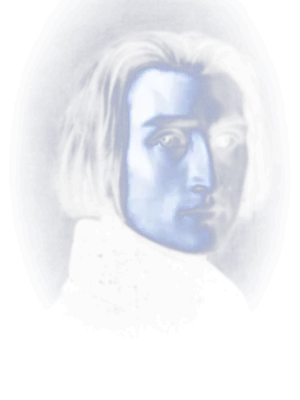
Born in 1811 in Raiding, then part of Hungary, Liszt studied in Vienna with Carl Czerny, then moved to Paris and toured Europe as a virtuoso pianist. From 1848 he settled in Weimar, where he conducted and composed his symphonic poems. For the piano he wrote études, a sonata, the Hungarian Rhapsodies and hundreds of transcriptions, many of them of Schubert songs: his version of the Ständchen (1838) is in the catalogue, on Schubert's page.
Start with the Ständchen or with Liebestraum No. 3, a piano version of one of his own songs. The latter works on a melody carried by the thumb in the middle of arpeggios, with spans of up to seventeen semitones. The other three pieces sit at the top level. Hungarian Rhapsody No. 6 ends with hundreds of right-hand octaves. La Campanella, on a theme by Paganini, strings together right-hand leaps up to the treble, and Hungarian Rhapsody No. 2 lasts more than eight minutes.